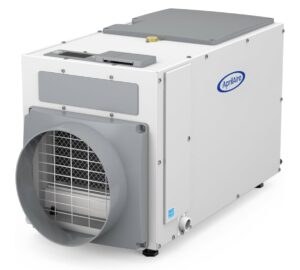
A whole-home dehumidifier is one of those purchases where the sizing decision matters more than the brand decision. Undersize it and it runs flat out forever and never catches the load. Oversize it and you paid a premium for capacity you use two weeks a year. The good news: you can get to the right size with a tape measure, a cheap hygrometer, and some honesty about your house.
Start with what the rating means
Dehumidifiers are rated in pints of water removed per day, measured at a standardized test condition. The number on the spec sheet was produced in a warm, very damp test chamber, and the machine will remove less in your actual basement at cooler temperatures. Treat the rating as a comparison tool between units, not a promise about your air. It is also why a ducted unit rated in the same pint class as a big-box portable will outperform it in practice: better coils, better airflow, and it serves the whole envelope instead of one corner.
The two-question sizing method
Question one: how much house? Total the square footage the unit will actually serve. For most installs that is the full conditioned footprint, because the unit ties into the duct system. For a basement-only install, it is the basement.
Question two: how wet is it? Be honest, and use symptoms, not pride:
- Slightly damp: air feels heavy on humid weeks, a musty smell shows up occasionally.
- Damp: musty smell is routine in summer, you can feel the moisture on stair treads or concrete.
- Wet: visible condensation on cold pipes or walls, seasonal seepage, mold spots you keep cleaning.
A modest, reasonably tight house in the slightly damp class typically lands in the smaller ducted sizes. Push up a class for a damp basement, an older leaky envelope, a crowd of daily showers, a crawlspace that communicates with the house, or a kitchen that runs hard. Push up again for the wet class, and fix the water entry first, because no dehumidifier is a substitute for gutters and grading.
Placement and ducting, where installs go wrong
A ducted dehumidifier needs to pull air from the house, dry it, and return it without fighting your HVAC blower. The common configurations, in rough order of preference:
- Dedicated return, supply into the HVAC return or supply trunk. The unit samples air from a representative spot, often a hallway or the basement, and pushes dry air into the duct system for distribution.
- Fully ducted to its own grilles. Most control, most sheet metal, common for crawlspaces and basements.
- Freestanding in the basement. Legitimate for basement-dominant moisture, as long as air can circulate to it.
Follow the manufacturer's rules about where the unit may discharge, and dampers where required, so you do not backfeed your air handler. Give the unit a real condensate path: a gravity drain to a floor drain if you have one, otherwise a condensate pump you test twice a summer.
Set it, then verify it
Set the dehumidistat around 50 percent relative humidity. Lower feels crisper but costs energy fast; higher invites dust mites and that cave smell. Then verify with a separate hygrometer in the space you care about, not the readout on the machine, which is reading its own inlet. Expect the unit to run hard for the first day or two while it pulls stored moisture out of framing, concrete, and furniture, then settle into cycles.
If it never settles, either the sizing missed or water is entering faster than you think. Recheck the symptoms list before blaming the machine: the most common failure in this category is a correctly sized dehumidifier heroically fighting an open crawlspace vent.
Pair the unit with the airflow and coil work in our humidity tune-up guide and July stops winning.
For local service context, see a roofing contractor such as Keys Roofing.